Exhibition · Crafts Narrative
The Soul of Craft:
Seven Centuries of Jingdezhen's Technical Artistry
This exhibition returns to the essence of ceramic art: the making itself.
Through seven pivotal techniques, it traces how generations of Jingdezhen artisans transformed clay and fire into enduring artistry, turning technique into an aesthetic language of its own. Each method reshaped the look and meaning of porcelain, responding to the cultural, social, and political forces of its time.
Magic with Clay and Fire! 🔥⚱️
How do lumps of mud turn into shiny, beautiful bowls? It's like magic, but it's actually science and art! In this tour, we will see 7 secret tricks (techniques) that potters in China used over 700 years to make their porcelain stronger, thinner, and more colorful. Let's see how they did it!
Technique is ontology.
This narrative deconstructs the history of Jingdezhen through the lens of 'technical objects' (Simondon). By isolating seven critical advancements—from cobalt application to high-temperature reduction firing—we examine how material constraints and innovations dictated aesthetic evolution. It posits that the 'Soul of Craft' is not merely artistic intuition, but a cumulative system of tacit knowledge and material science.
Technique 1
Foundation: Cobalt and the Art of Underglaze Painting
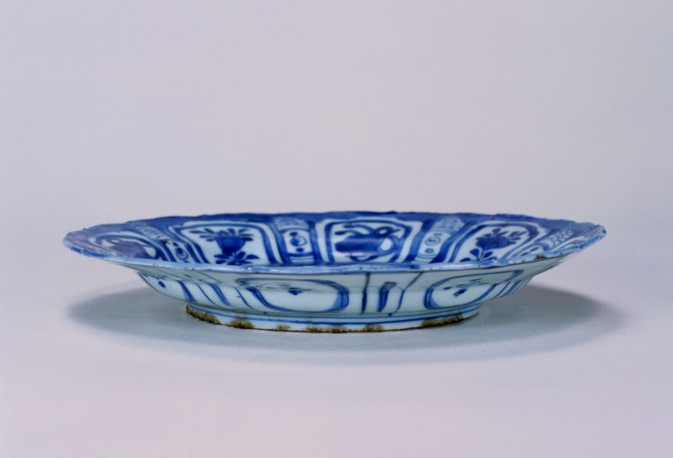
Object: Blue-and-White Dish (cat. no. 2)
Blue-and-white porcelain is a form of underglaze decoration. Artisans paint cobalt pigment directly onto the dried clay body, apply a clear glaze, and fire the piece once in a reducing atmosphere at around 1300°C. In the kiln, the cobalt turns a vivid blue and becomes permanently sealed beneath the glaze, giving the decoration its timeless, unfading colour.
Painting Before Baking 🖌️
Imagine drawing a picture that never fades! Potters painted with a special blue ink called "cobalt" on the clay BEFORE putting it in the oven. Then they put a clear glass-like coat over it. When it came out, the blue picture was trapped inside the glass forever!
The mastery of underglaze cobalt marks the transition to high-temperature painted ceramics. The technical challenge lay in controlling the diffusion of cobalt oxide at 1300°C within a reducing atmosphere. This success established the "Blue and White" hegemony in global ceramics, defining a new visual standard of permanence and contrast.
Technique 2
The Birth of Doucai: The First Dialogue Between Underglaze and Overglaze
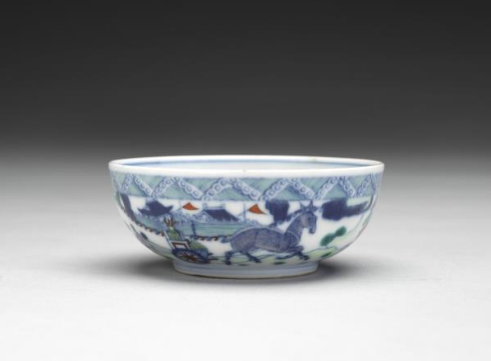
Object: Doucai Bowl (cat. no. 3)
Doucai combines two firings. First, cobalt outlines are painted and fired under a clear glaze to produce a blue-and-white base. Then coloured enamels are applied within the outlines and fired again at around 800°C. The appeal of doucai lies in the harmony between the calm underglaze blue and the bright overglaze colours.
Coloring Inside the Lines 🖍️
This is like a coloring book! First, the artist draws the blue outlines and bakes the bowl. Then, they fill in the shapes with red, green, and yellow paints and bake it AGAIN. It takes double the work to make it look this pretty!
Doucai ("Contending Colors") represents a significant leap in kiln management: the synchronization of high-temperature reduction firing (for the underglaze blue outline) and low-temperature oxidation firing (for the overglaze enamels). It conceptualized the ceramic surface as a layered space, integrating two distinct material palettes.
Technique 3
The Flourishing of Wucai: The Independence of Overglaze Colour
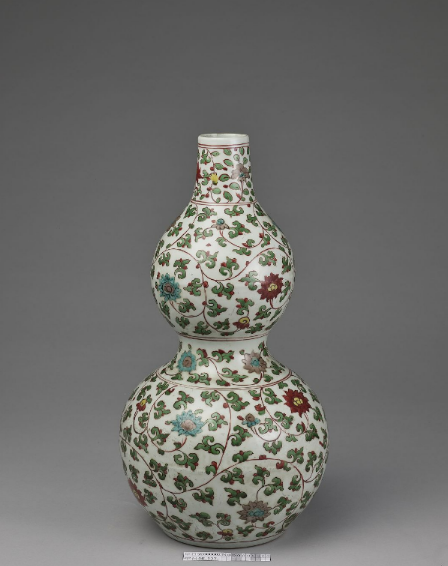
Object: Wucai Gourd Vase (cat. no. 1)
Wucai is a fully developed overglaze enamel technique. Bright pigments, typically red, yellow, green and purple, are painted directly onto an already-fired white glaze and fixed through a low-temperature refiring. With its bold contrasts and vivid palette, wucai marks the independence of overglaze painting from the blue-and-white tradition.
Five Colors Party! 🎉
Wucai means "Five Colors". Instead of just blue, artists now used lots of bright red, green, and yellow on top of the white porcelain. It's like painting with bright markers on a whiteboard!
Wucai signifies the liberation of polychrome enamels from the subservience to underglaze blue outlines (as in Doucai). By applying robust, opaque enamels directly onto the fired glaze, artisans achieved a more painterly and expressive freedom, setting the stage for the later developments of the Famille Verte palette.
Technique 4
Falangcai at Its Peak: A Royal Technique of Western Origin
Object: Falangcai Tea Bowl (cat. no. 5)
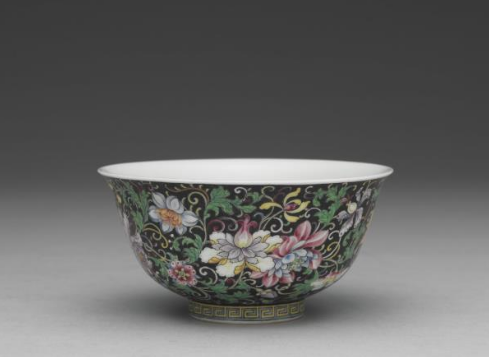
Falangcai, or enamel painting on porcelain, employs enamel pigments introduced from the West. These colours are stable, richly varied, and visually textured. Jingdezhen provided the fine white bodies, which were then painted by court artists and fired at low temperatures in the imperial workshops. Thin, delicate, and exquisitely detailed, falangcai represents the height of Qing court craftsmanship.
The Emperor's Secret Recipe 🤫
This tiny bowl is super special. The white cup was made in Jingdezhen, but it was sent all the way to Beijing to be painted inside the Emperor's palace using special paints from Europe. Only the Emperor and his family could use these!
Falangcai ("Enamel Colors") represents a unique instance of imperially monopolized production. The introduction of borate-based enamels from Europe allowed for a wider chromatic range and the ability to blend colors (shading). This technique was restricted to the Palace Workshops (Zaobanchu), creating a distinct class of porcelain divorced from the commercial output of Jingdezhen.

Technique 5
Yangcai: The Sinicized Expression of Western Aesthetics
Object: Yangcai Vase (cat. no. 6)
Yangcai shares its materials and techniques with falangcai, including Western enamels and shading. However, its motifs and layouts are distinctly Chinese, often using patterned grounds and shaped panels. If falangcai reflects a desire to emulate Western painting, then yangcai represents the integration of Western methods into Chinese decorative traditions.
Western Paints, Chinese Style 🏮
After learning the secret recipes from Europe, Chinese artists started using them to paint traditional Chinese pictures, like birds and flowers. "Yangcai" basically means "Foreign Colors", but used in a very Chinese way!
Yangcai ("Foreign Colors") marks the industrialization of the Falangcai palette at Jingdezhen. While chemically similar to court enamels, Yangcai was produced in the imperial kilns for broader palace use. Stylistically, it is characterized by the use of "sgraffito" (incised designs) on colored grounds and the integration of Western shading into traditional floral compositions.
Technique 6
Narrative in Famille-Rose: Brushwork, Story, and Modern Innovation
Object: Famille-rose Vase "Mulan" (cat. no. 11)
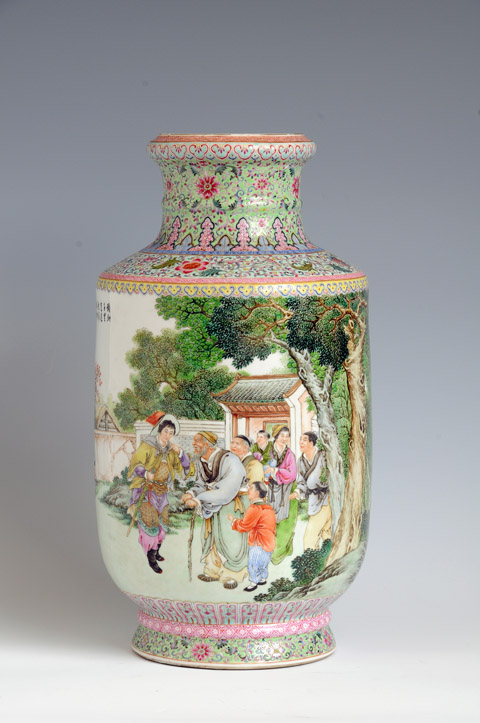
Famille-rose enamels allow for subtle shading and soft transitions of colour, making them ideal for narrative scenes. On this vase, the story of Mulan's return is rendered with fluid lines and delicate modelling, echoing the techniques of traditional figure painting. Created by the modern Jingdezhen master Wang Dafan, the piece shows how Republican-period artists merged literati painting aesthetics with enamel decoration on porcelain.
Story Time on a Vase 📖
This vase tells the story of Mulan! Because the new paints were so soft and easy to mix (like watercolors), artists could paint people's faces and clothes very gently. It looks just like a painting on paper, but it's on a hard vase!
This work by Wang Dafan exemplifies the "New Porcelain Art" of the Republic period. The technique of Famille-Rose (Fencai) is here liberated from decorative pattern to serve as a medium for literati-style painting. The focus shifts from the technical perfection of the glaze to the individual brushwork and narrative capability of the artist.
Technique 7
The Limits of Thin-Body Porcelain: Mastery of Form and Fire
Object: Nine Cranes Dancing (cat. no. 11)
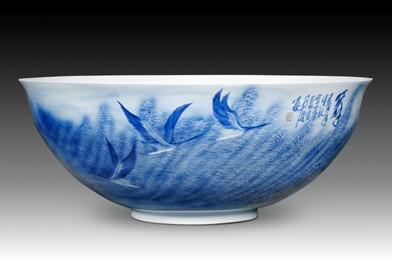
Thin-body porcelain demands extraordinary control during forming. The clay must be thrown to an extremely thin and even body, then survive drying and firing at around 1300°C without warping or collapsing. Successfully made pieces transmit light and ring like a chime, a testament to the highest mastery of Jingdezhen's forming techniques.
Thin as an Eggshell 🥚
This bowl is so thin that light can shine through it! It's super hard to make because the clay can easily collapse in the hot oven. Only the very best masters can make something this delicate without breaking it.
Eggshell porcelain (Boddiless ware) pushes the structural limits of the kaolin-petuntse matrix. The technique requires extreme precision in trimming (xiupi) to achieve walls less than 1mm thick. This represents the ultimate triumph of craftsmanship over material fragility, creating an object that is visually ethereal yet physically resilient.
Technique Epilogue · Learning to Read Surfaces
Seen through technique, porcelain is a record of choices: which clay to refine, which pigments to mix, which firing schedule to trust. The seven sections of this exhibition invite visitors to read surfaces not only as images, but as traces of bodies, tools, and fire.
Secrets in the Clay 🔍
Next time you see a cup or plate, look closely! Can you see the blue paint under the glass? Can you feel the bumps of the enamel? Now you know the secrets of how they were made. Porcelain is not just a dish; it's a science experiment that turned into art!
In conclusion, "The Soul of Craft" argues for a materialist reading of art history. By focusing on process rather than just iconography, we reveal porcelain as an accumulation of technical breakthroughs. These seven techniques demonstrate how material innovation drives aesthetic change, turning the kiln into a laboratory of cultural production.